Showing posts with label konnyaku. Show all posts

Friday, February 19, 2010

Gobo ごぼう


Sorry I haven't posted in ages!  Things have been pretty hectic here with the end of the school year coming up.  To make up for it I'll do two posts tonight :)

Gobo is Japanese burdock and the big, dirt-covered root things you see in the supermarket.  It has a nice crunch and almost nutty flavor.  You'll often see it in school lunch and in Japanese restaraunts in various forms.  My personal favorite is fried gobo you will sometimes find in izakayas.  If you are lazy like me, you can find gobo that has already been cleaned and julienned in bags near the bean sprouts and bamboo shoots.  But it's kind of expensive to buy it that way so it's really better to buy it fresh and prepare it yourself.
How to Prepare
It's important to thoroughly clean gobo before you use it.  Scrub the gobo with hot water until you have gotten most of the dirt off of it.  Then you want to take a knife and scrap off the outer skin of the gobo to remove any remaining dirt.  Usually gobo is cut into matchstick sized pieces but you can also chop, dice, etc.  It will just take longer to cook done that way.

After you have cut your gobo up into matchstick sized pieces, it's important to allow the gobo to soak in water for at least 10 minutes.  If you don't do this, the gobo will have an overwhelmingly strong taste.  10 minutes should do the trick but it's okay to allow it to soak for longer.

Easy Gobo Recipe

There are tons of ways to use gobo, though you will usually find it in soups, stir-fries, and Japanese-style salads.  Here is a simple vegetable soup that can be made with gobo.   From start to finish, this soup takes about 25 minutes to prepare.

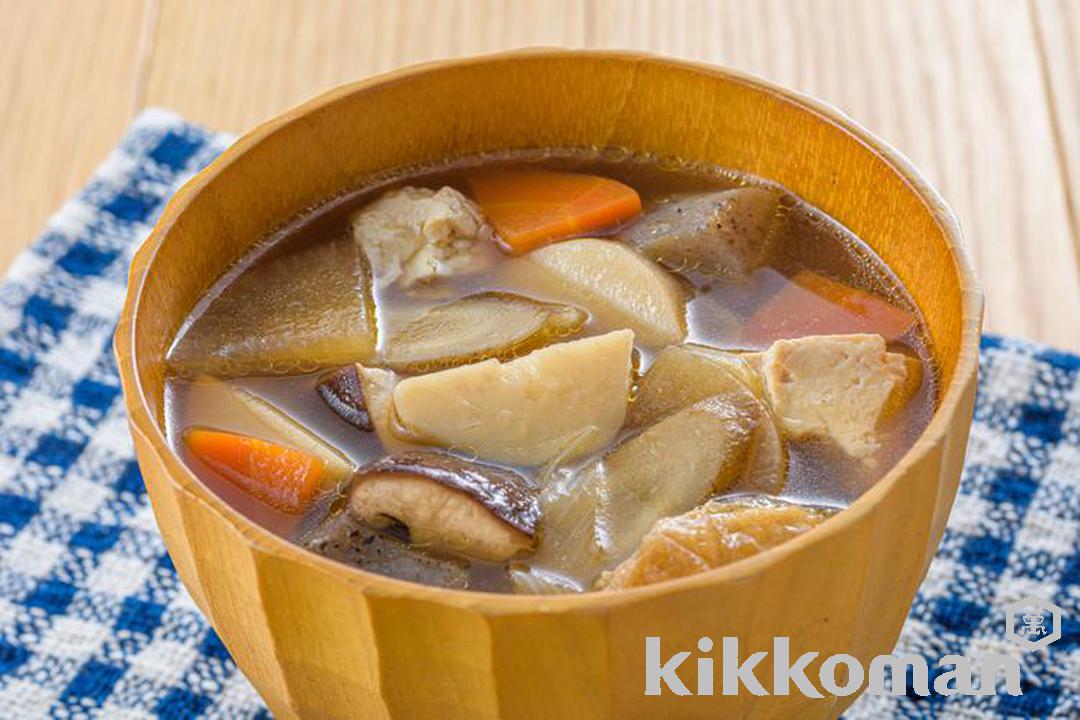
Kenchin Soup
Makes 4 servings

Prep Time: About 1 hour

Ingredients:
  • 1 block tofu
  • 6cm length of daikon radish
  • 1/2 a carrot
  • 3 shiitake mushrooms
  • 1/3 stalk gobo
  • 1/2 block konnyaku こんにゃく
  • 1 sheet fried tofu 油揚げ
  • 3 taro roots 里芋 (can substitute baby sized potatoes)
  • 1/2 bundle Japanese mustard spinach 小松菜
  • 2 tablespoons oil
  • 2 teaspoons dashi (fish stock)
  • 1.5 tablespoons soy sauce
  • 1/2 teaspoon salt
  • 2 tablespoons sake
Preparation:
1.     Drain water from the tofu.
2.     Cut daikon and carrot into thin half moon shaped slices.   
3.     Destem the mushrooms and cut caps into quarters.
4.     Cut gobo into thin, round slices and place in water for 10 minutes. Drain water.
5.     Peel the skin from the taro roots, salt the outside of the taro, allow to sit for a minute and then wash the taro.
6.     Cut the konnyaku into large bite-sized pieces.  Wash thoroughly.
7.     Place the fried tofu into boiling water until most of the oil has been removed from the tofu.  Remove from the water and cut into bite-sized pieces.
8.     Heat oil in the soup pot over medium-high.  Add daikon, carrots, mushrooms, gobo, taro, konnyaku, and fried tofu to the pot.  Stir fry for about two minutes.
9.     Add dashi and water to the pot.  Bring to a boil, then lower heat so the water is simmering.  Skim the top of the soup once every couple of minutes to remove any scum that rises to the top. 
10.  While soup is simmering, cut the drained tofu into 4cm blocks.  Separate out the bunch of Japanese mustard spinach.
11.  Add tofu and spinach to the pot.  Add soy sauce, salt, and pepper to the pot. 
12.  Remove pot from heat once tofu has heated through.
13.  Finished!


Thursday, January 28, 2010

Konnyaku こんにゃく


Konnyaku is a curious thing.  Is it a vegetable, an animal, an amorphous blog of atoms?  Turns out it actually is a plant, and an ugly one at that.  I'd be curious to know why the first human who ate it decided to even approach the thing.  Maybe he was starving and delirious in the jungle.  Apparently it's called konjak in English, but as I've never heard that word in my life, I'm content to call it konnyaku.  Konnyaku doesn't have much of a taste and comes in a variety of shapes and sizes, all of them gelatinous in nature.  You can also get konnyaku that has been infused with such things as mushrooms and cayenne pepper.  My favorite is the spicy konnyaku, particularly the noodle shaped one.
As far as nutrition goes, you know the cabbage diet?  The one where you eat lots and lots of cabbage because it has very little calories or nutritional value  so you can eat as much as you want?  Konnyaku is Japan's answer to the cabbage diet.  It's fat free, contains next to nothing in calories, and has lots of fiber.  So it's a great filler food but don't rely on it as your sole sustainance.  Probably the greatest thing about konnyaku is it's cheap, so you can throw it in to just about any recipe to bulk it up without affecting its flavor.


How to Prepare
Konnyaku comes packed usually in fish broth so you'll want to drain that.  You can find varieties that are packed in water as well.  Once it's drained it's ready to go!  If you buy a big block you can cut it into any shape you want.  Or you can buy ones shaped as noodles, balls, on a stick, if you can imagine it, konnyaku has been shaped into it.  Konnyaku can be eaten hot or cold, stewed, steamed, boiled, frozen, just about any way you want.

Easy Konnyaku Recipe

My favorite way of eating konnyaku is in nabe, but you can also throw it into stir-fries and other dishes easily.

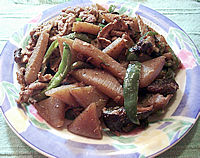
Pork and Konnyaku Miso Stir-fry

Makes 4 servings

Prep Time: About 1 hour

Ingredients:


  • 2 sheets of konnyaku, cut into triangles
  • 150 grams pork, cut into 4 cm strips
  • 1 tablespoon sesame oil
  • 1 small pack shiitake mushrooms, destemmed and cut into halves
  • 2 green peppers, cut into strips
  • 1/2 onion, thinly sliced
  • 2 cups cabbage, chopped
  • 3 tablespoons cooking sake, divided
  • 2 tablespoons soy sauce, divided
  • 2 teaspoons sugar
  • 1 teaspoons garlic, minced
  • 1 teaspoons ginger paste
  • 1 teaspoons togarashi
  • 1 tablespoon water
  • 30g miso paste 味噌
Preparation:
1.  Mix together 2 tablespoons sake, 1 tablespoon soy sauce, miso paste, sugar and water.  Add pork and konnyaku to the marinade.  Allow to marinate for about 20 minutes.
2.  In a frying pan, heat sesame oil over medium high.  Add onions to frying pan.  Saute until starting to become translucent.
3.  Add green peppers, cabbage and mushrooms to frying pan.  Saute for 3-4 minutes, or until green peppers being to soften.
4.  Add garlic, ginger, togarashi, remaining sake and soy sauce.  Saute for 1 minute or until fragrant.
5.  Add pork, konnyaku, and sauce.  Saute until pork has browned and sauce has begun to thicken.
6.  Serve with rice.
7.  Finished!


Wednesday, December 30, 2009

Bunashimeji ぶなしめじ

Sorry about the long hiatus!  I took a trip out to Saipan and then spent the past week just catching up on relaxation.  I can't remember the last time I had a week to sit around and do nothing.  I hope everyone else had a good holiday season!


Amanda requested I talk about shimeji mushrooms and here they are.  I personally love shimeji and will throw them in just about any recipe where mushrooms can be added.  They usually come in a big bunch and can be found in brown and white varieties.  Their firm texture make them perfect for stews and stir fries since they won't break up like other varieties of mushrooms tend to.  Shimeji are also low in calories and high in niacin; they're also believed to have anti-tumor agents in them!

How to Prepare
You'll want to cut off the bottom section where the mushroom was growing.  Then break up the mushroom into chunks or individual stems.

Easy Shimeji Recipe

If you've never had sukiyaki before, now's the time to start!  Sukiyaki is big in Japan, especially during the cold winter months.

Sukiyaki


Serves 4

Prep Time: About 1 hour

Ingredients:

  • 300g shimeji mushrooms (1 package)
  • 1/3 head Chinese cabbage 白菜
  • 2 leeks
  • 400g beef (ask your butcher to thinly slice the beef like deli meat, or if you're in Japan look for うす切り牛肉.  It should look like the picture)
  • Shirataki, one bag drained (shirataki is a type of konnyaku.  It looks like translucent noodles before it's cooked.  It can be found at most Asian markets as しらたき.  If you can't find it, it can be omitted)
  • 1 block grilled tofu 焼き豆腐, drained (can be found at most Asian markets.  If you can't get pre-grilled tofu, buy firm tofu and grill it yourself).
  • 4 eggs, beaten
Sukiyaki Broth
  • 1 package powdered kombu broth 昆布だしの素 (can be found at Asian markets and Whole Foods)
  • 1 cup hot water
  • 4 tablespoons sugar
  • 1 tablespoon mirin
  • 1 tablespoon soy sauce

Preparation:
1. In a small bowl, mix together all the ingredients for the sukiyaki broth.  Set aside.
2. Cut bottom off the shimeji mushrooms and cut into small sections.
3. Cut the Chinese cabbage into bite-sized chunks.  Cut bottom and dark green parts off the leeks.  Cut into bite-sized slices.
4. Drain tofu and cut into 1 inch cubes.  Drain the shirataki.
5. In a nabe pot or medium sized heavy pot, add the sukiyaki broth.  Bring to a boil, then reduce to a simmer.  Add the mushrooms, cabbage, leeks, tofu, and shirataki.  Spread everything out evenly in the pot.
6. On top of all that, spread out the slices of beef evenly. 
7. Once the beef begins to change color, add the beaten egg to the sukiyaki.  Cook until the vegetables are to your liking.
8. Finished!

Sukiyaki is a very easy weeknight meal.  Try it out!