Showing posts with label side. Show all posts

Thursday, March 18, 2010

Seri セリ


Man have I gotten bad about updating.  I apologize.  If anyone can figure out a way for me to be able to post from work I'm all ears!

Seri, known as Japanese parsley or Chinese celery, is a springtime vegetable found for only a few short weeks here in Japan.  Seri is high in vitamins C and A as well as potassium.  It tastes great fresh just thrown in a salad and can also be used in stews, stir-fries, and soups.

How to Prepare
Make sure to select seri that is bright in color and not wilted or musty looking.  It should look similar to cilantro or other leafy herbs.  From there just chop it up and throw it in your recipe!

Easy Seri Recipe

While seri is best known for its role in the traditional spring dish nanakusa no sekku, all seven of those vegetables can kind of be a pain to get a hold of.  Instead will make a tasty fresh salad with our seri!

Seri and Chicken Salad
Makes 4 servings

Prep Time: About 30 minutes

Ingredients:
  • 1 bunch of seri
  • 300 grams chicken breast
  • 1/2 a red onion
  • 40 grams harusame (super thin rice noodles)
  • 4 tablespoons peanuts, crushed
  • pinch of salt
  • 2 teaspoons and 2 tablespoons vinegar, divided
  • 2 teaspoons fresh lemon or lime juice
  • 4 tablespoons fish sauce (also known as nam pla)
  • 1 tablespoon sugar
  • 1 togarashi pepper, chopped or 1 teaspoon dried togarashi
  • 1 clove garlic, minced
  • 1/2 teaspoon minced ginger
Preparation:

1.     Roughly chop seri.  Thinly slice the red onion and place into cold water.
2.     Cook harusame according to package directions, then place in cold water to stop from cooking further.  Drain and chop into bite sized strands.
3.    Cut chicken into bite sized pieces.  Season with pinch of salt and 2 teaspoons vinegar.  Cook in microwave for two minutes or until cooked through.
4.    Mix together remaining vinegar, lemon juice, fish sauce, sugar, togarashi, garlic, and ginger.
5.   Drain red onions.  Toss together seri, onion, harusame, chicken, and dressing.
6.  Place into small bowls and garnish with peanuts.
7.  Finished!


Friday, January 15, 2010

Mikan みかん


Right now it's peak season for mikan, those little citrus fruits that I could eat by the dozen if I'm not careful.  In English they're known as clementines or satsuma oranges depending on where you live.  I've heard the term satsuma orange has to do with one of the areas where mikan are grown in Japan, but the only place I know of where mikan are worth their snuff is Wakayama.  Like most citrus, mikan are packed with vitamin C so grab a couple if you want to ward off the scurvy, yarr!

How to Prepare
One of the best things about mikan is they're so easy peel.  I actually loath dealing with navel oranges now after having lived with mikan so for long.  The peel of mikan is also great for cooking and especially baking, so don't let it go to waste!

Easy Mikan Recipe

This may sound like a funky combo for a salad but it's actually delicious!  As an added bonus, endives are one of those random vegetables that for some reason are cheaper in Japan than in the US.  I don't really get how that one works.

Citrusy Endive Salad

Makes 4 servings

Prep Time: About 30 minutes

Ingredients:

  • 1 tablespoon balsamic vinegar
  • 1/2 teaspoon honey
  • 1/4 teaspoon salt
  • 2 tablespoons olive oil
  • 3 to 5 mikan, peeled and segmented
  • 2 to 3 endives (エンダイブ or チコリー)
  • 2 inner ribs of celery (the pale white looking ones), including leaves
  • 1/4 cup black olives, pitted and cut into slivers
  • 1/2 cup thinly sliced red onion
  • 1/4 cup chopped parsley or loosely packed flat-leaf parsley
Preparation:
1. Whisk together vinegar, honey, and salt in a small bowl until salt are dissolved, then add oil in a slow stream, whisking well. Season with pepper.
2. Remove the pith from your mikan segments but don't worry about being anal retentive, just remove the biggest chunks.
3. Halve endives lengthwise, then cut out and discard the cores. Cut endives diagonally into 1/2-inch-wide strips and put in a large salad bowl.
4. Separate celery leaves from ribs and cut ribs diagonally into very thin slices.
5. Roughly chop the celery leaves.  Add the leaves, ribs, olives, onions, parsley, and mikan to the endives.
6. Whisk dressing, then gently toss salad with enough dressing to coat.
7. Finished!

An easy salad for a light weeknight meal!


Saturday, December 12, 2009

Nashi 梨


Asian pears: crispy, juicy, delicious.  And because they are much firmer than their European counterparts, can be used as a substitute for apples in most recipes.  Asian pears are high in fiber as well as vitamins K and C.

How to Prepare
You can prepare an Asian pear the same way you would apples.  Just decore and start cooking!

Easy Asian Pear Recipe

The first year I was in Japan there were some Asian pears hanging out in the clearance bin of my local supermarket.  Regardless of the fact that I had eaten Asian pears plenty of times in the States, for some reason I was under the delusion they were apples.  So I bought them with the intention of making some applesauce with them.  Even when I got home and was decoring and chopping up these "apples" I was thinking, "Gee, these are some juicy apples!"  It wasn't until I had finished making the "applesauce" that I realized they were Asian pears.  A really dumb moment in my kitchen but it turned out to be delicious!

Pearsauce

Serves 4

Prep Time: About 30 mins

Ingredients:

  • 6-8 large Asian pears, peeled, cored, cut into small pieces
  • 1/2 cup water
  • 1/4 cup brown sugar
  • 2 tablespoons fresh lemon juice
  • 1 1/4 teaspoons ground cardamom or cinnamon
  • 1/2 teaspoon fresh grated ginger
Preparation:
1. Combine all ingredients in heavy medium saucepan. Cover, bring to boil.
2. Reduce heat to medium-low; simmer until apples are very tender, stirring occasionally, about 30 minutes.
3. Cool slightly.
4. Smush pears with a potato masher or a pork for chunky sauce. For smooth sauce, transfer to a blender and blend until smooth.
5. Finished!

One thing my great-grandmother would always do when she made homemade applesauce was to serve it warm with a dollop of sour cream on top.  It's just as delicious when done with this pearsauce.

Thursday, December 10, 2009

Beni-imo 紅芋

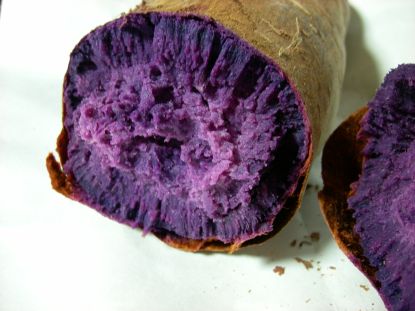
In Japan, schools often take their class trip to Okinawa, a subtropical island a stone's throw from Taiwan.  One of the better known vegetables from Okinawa is purple sweet potatoes, known as beni-imo or murasaki-imo in Japanese.  I found them at the market today so they're officially in season!  Purple sweet potatoes are awesome because they're bright purple.  How many natural foods can claim that?  They have a milder taste than orange sweet potatoes but can be used in all the same ways.  I've even made purple sweet potato pie from these potatoes which made the pie look like it was radioactively glowing.  Kick ass!

Outside of Japan, I have heard more and more markets are carrying purple sweet potatoes.  So take a look around or ask your local farmers at the farmers' market.  Maybe if you pique their interest enough they'll look into growing them!

How to Prepare
Same way you would any potato:

Easy Beni-imo Recipe
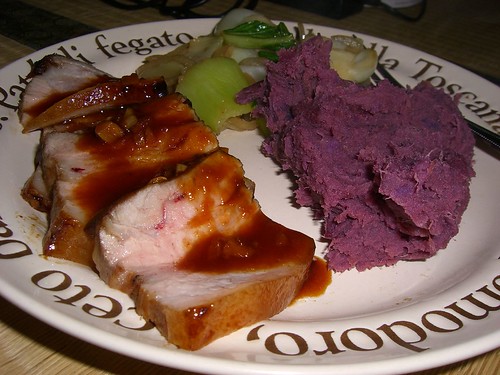
When your star ingredient is such a cool color, you want a way to showcase it!

Jazzed Up Mashed Sweet Potatoes

Serves 2-3

Prep Time: About 30 mins

Ingredients:
  • 2 large purple sweet potatoes, either roasted in the oven or cooked in the microwave
  • 2 tablespoons butter or olive oil
  • 1/4 cup milk
  • 1/2 teaspoon salt
  • 1/4 teaspoon togarashi
  • 1/4 teaspoon cinnamon
  • 1/2 teaspoon finely grated lime zest
  • 1.5 tablespoons lime juice
  • 1/4 cup chopped fresh cilantro OPTIONAL
Preparation:
1. Cut open sweet potatoes and scoop out their innards into a bowl.
2. Add rest of the ingredients.  Mash together until well blended.
3. Serve!

I really like these potatoes with some pork chops or chicken that has been marinated in some sort of cumin marinade.