Showing posts with label shiitake. Show all posts

Friday, February 19, 2010

Kogomi コゴミ

I'm on a roll so why not post another recipe lol.

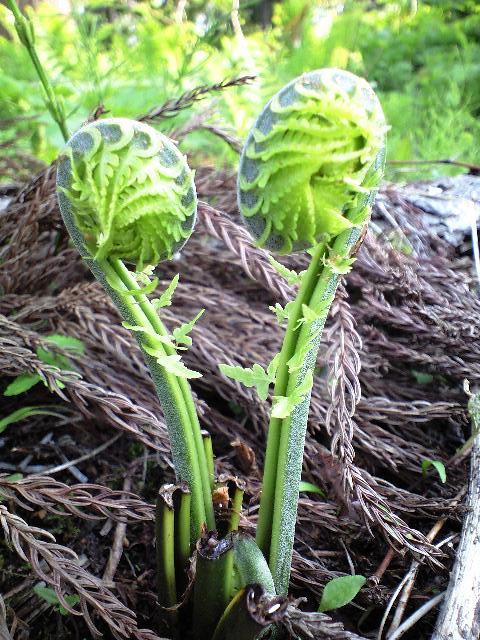
Kogomi are the tender sprouts of the ostrich fern or fiddlehead fern.  It might weird you out to think of eating a fern but these are one of the most delicious plants you can sink your teeth into in the spring!  But you can usually only get them for about 3-4 weeks once you see them start popping up in the supermarket so make sure you grab them when you do see them!

They taste like a cross between asparagus and brussel sprouts, making them an easy addition to pastas, sautes, and so on (as my students would say).  In Japan they tend to be included in salads, tempura, and stewed dishes.

How to Prepare
With kogomi you want to cut off the bottom inch of the stem where it has hardened and then give them a quick rinse.  From there you can fry, saute, stew, basically any way you would prepare asparagus you can also prepare kogomi.

Easy Kogomi Recipe

Garlic sprouts are easy to include in just about any recipe.  This stir-fry recipe is super easy and only takes about 45 minutes to make including marinating time.

Kogomi Pasta
Makes 2 servings

Prep Time: About 45 minutes

Ingredients:
  • 8-10 kogomi heads
  • enough pasta for 2 people (about 150 grams)
  • 5-6 small shiitake mushrooms, destemmed and sliced, or maitake mushrooms, chopped
  • 1/2 small onion, thinly sliced
  • 1 garlic clove, minced
  • 1.5 tablespoons olive oil
  • 1/4 cup fresh grated Parmesan cheese
  • 2 teaspoons fresh lemon juice
Preparation:

1.     Add kogomi to a large pot of boiling salted water. Cook until just crisp-tender. Transfer to bowl of cold water using slotted spoon. Cool kogomi slightly to stop it from cooking and drain. 
2.     Add pasta to same pot of water and boil until just tender but still firm to bite.  Drain well.
3.    Heat olive oil over medium heat in a saucepan.  Add onions and saute until starting to brown.
4.    Add garlic and saute 1 minute.
5.   Add mushrooms and lemon juice and saute until just starting to become tender.
6.  Add kogomi and pasta.  Stir well.
7.  Add cheese and stir until full incorporated.
8. Finished!


Ninniku no Me にんにくの芽


Ninniku no me is the Japanese name for garlic sprouts.  These greens are super tasty with a light garlic flavor.  They are usually sold in packs in the refrigerated section and are a versatile vegetable.
How to Prepare
Garlic sprouts are similar to asparagus in texture and can be used in the same ways.  Simply cut them down to whatever size you want and start cooking.  Garlic sprouts can be a little tough when raw so it’s best to cook them first, though if chopped finely they can be thrown in with salad or fresh spring rolls.  I most often use them in stir fries and sautés cut into bite sized pieces.

Easy Garlic Sprouts Recipe

Garlic sprouts are easy to include in just about any recipe.  This stir-fry recipe is super easy and only takes about 45 minutes to make including marinating time.

Garlic Sprouts Stir-fry
Makes 2-3 servings

Prep Time: About 45 minutes

Ingredients:
  • 3 tablespoons soy sauce
  • 1 tablespoon rice vinegar 米酢
  • 1 tablespoon honey
  • 1 teaspoon sesame oil ゴマ油
  • 1/2 teaspoon dried red pepper とうがらし
  • about 200 grams chicken, cut into bite sized pieces
  • 1/4 cup water
  • 1 teaspoon cornstarch コーンスターチ
  • 2 tablespoons sesame oil, divided
  • 6 shiitake mushrooms, stemmed, caps quartered
  • 1 colored bell pepper, cut into strips
  • 1/2 package garlic sprouts, cut into bite sized pieces
  • 1 tablespoon minced fresh ginger
  • 1/2 cup matchstick sized carrot strips
  • 1/2 cup broccoli, cut into bite sized pieces
Preparation:

1.     Whisk first 5 ingredients in medium bowl to blend.
2.     Add chicken and stir to coat; let marinate 30 minutes.
3.     Drain, reserving marinade in small bowl. Whisk 1/4 cup water and cornstarch into marinade.
4.     Heat 1 tablespoon oil in large skillet over medium-high heat.
5.     Add chicken and sauté until golden, about 3 minutes. Using slotted spoon, transfer chicken to plate.
6.     Add remaining 1 tablespoon oil to skillet.
7.     Add mushrooms and stir-fry until tender, about 3 minutes.
8.     Add carrots, broccoli and garlic greens; stir-fry 2 minutes.
9.     Add bell peppers; stir-fry 2 minutes.
10.  Add garlic and ginger; stir-fry 30 seconds.
11.  Return chicken to skillet; drizzle reserved marinade mixture over everything.
12.  Stir-fry until marinade thickens slightly, about 30 seconds. Season to taste with salt and pepper.
13.  Finished! 


Gobo ごぼう


Sorry I haven't posted in ages!  Things have been pretty hectic here with the end of the school year coming up.  To make up for it I'll do two posts tonight :)

Gobo is Japanese burdock and the big, dirt-covered root things you see in the supermarket.  It has a nice crunch and almost nutty flavor.  You'll often see it in school lunch and in Japanese restaraunts in various forms.  My personal favorite is fried gobo you will sometimes find in izakayas.  If you are lazy like me, you can find gobo that has already been cleaned and julienned in bags near the bean sprouts and bamboo shoots.  But it's kind of expensive to buy it that way so it's really better to buy it fresh and prepare it yourself.
How to Prepare
It's important to thoroughly clean gobo before you use it.  Scrub the gobo with hot water until you have gotten most of the dirt off of it.  Then you want to take a knife and scrap off the outer skin of the gobo to remove any remaining dirt.  Usually gobo is cut into matchstick sized pieces but you can also chop, dice, etc.  It will just take longer to cook done that way.

After you have cut your gobo up into matchstick sized pieces, it's important to allow the gobo to soak in water for at least 10 minutes.  If you don't do this, the gobo will have an overwhelmingly strong taste.  10 minutes should do the trick but it's okay to allow it to soak for longer.

Easy Gobo Recipe

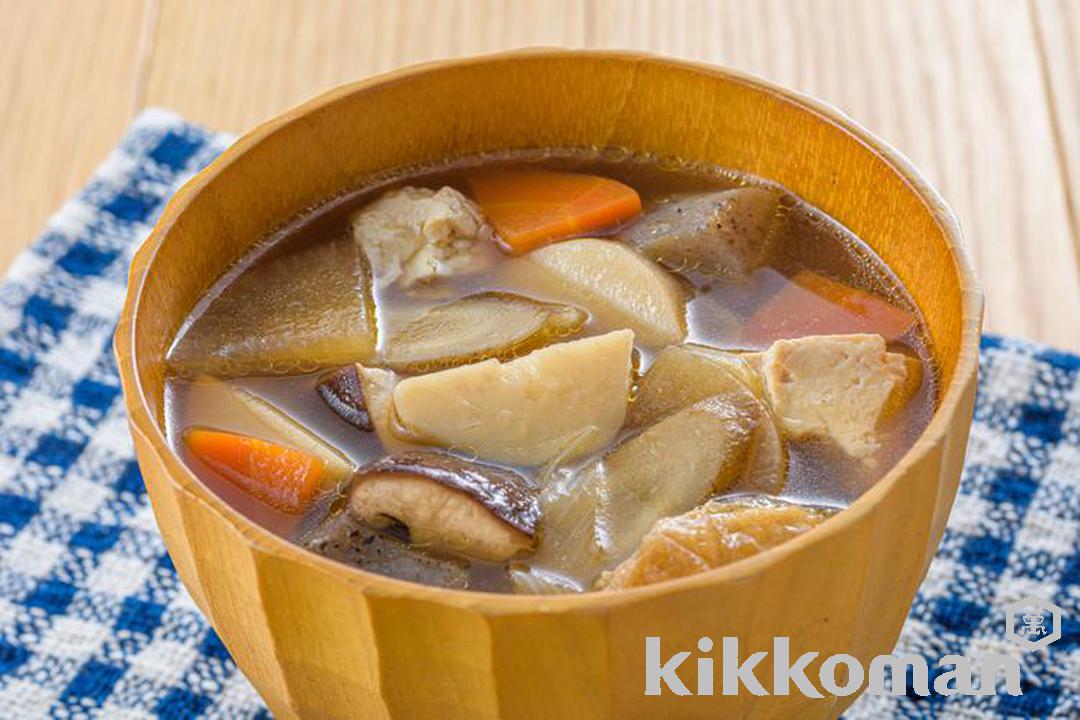
There are tons of ways to use gobo, though you will usually find it in soups, stir-fries, and Japanese-style salads.  Here is a simple vegetable soup that can be made with gobo.   From start to finish, this soup takes about 25 minutes to prepare.

Kenchin Soup
Makes 4 servings

Prep Time: About 1 hour

Ingredients:
  • 1 block tofu
  • 6cm length of daikon radish
  • 1/2 a carrot
  • 3 shiitake mushrooms
  • 1/3 stalk gobo
  • 1/2 block konnyaku こんにゃく
  • 1 sheet fried tofu 油揚げ
  • 3 taro roots 里芋 (can substitute baby sized potatoes)
  • 1/2 bundle Japanese mustard spinach 小松菜
  • 2 tablespoons oil
  • 2 teaspoons dashi (fish stock)
  • 1.5 tablespoons soy sauce
  • 1/2 teaspoon salt
  • 2 tablespoons sake
Preparation:
1.     Drain water from the tofu.
2.     Cut daikon and carrot into thin half moon shaped slices.   
3.     Destem the mushrooms and cut caps into quarters.
4.     Cut gobo into thin, round slices and place in water for 10 minutes. Drain water.
5.     Peel the skin from the taro roots, salt the outside of the taro, allow to sit for a minute and then wash the taro.
6.     Cut the konnyaku into large bite-sized pieces.  Wash thoroughly.
7.     Place the fried tofu into boiling water until most of the oil has been removed from the tofu.  Remove from the water and cut into bite-sized pieces.
8.     Heat oil in the soup pot over medium-high.  Add daikon, carrots, mushrooms, gobo, taro, konnyaku, and fried tofu to the pot.  Stir fry for about two minutes.
9.     Add dashi and water to the pot.  Bring to a boil, then lower heat so the water is simmering.  Skim the top of the soup once every couple of minutes to remove any scum that rises to the top. 
10.  While soup is simmering, cut the drained tofu into 4cm blocks.  Separate out the bunch of Japanese mustard spinach.
11.  Add tofu and spinach to the pot.  Add soy sauce, salt, and pepper to the pot. 
12.  Remove pot from heat once tofu has heated through.
13.  Finished!


Thursday, January 28, 2010

Konnyaku こんにゃく


Konnyaku is a curious thing.  Is it a vegetable, an animal, an amorphous blog of atoms?  Turns out it actually is a plant, and an ugly one at that.  I'd be curious to know why the first human who ate it decided to even approach the thing.  Maybe he was starving and delirious in the jungle.  Apparently it's called konjak in English, but as I've never heard that word in my life, I'm content to call it konnyaku.  Konnyaku doesn't have much of a taste and comes in a variety of shapes and sizes, all of them gelatinous in nature.  You can also get konnyaku that has been infused with such things as mushrooms and cayenne pepper.  My favorite is the spicy konnyaku, particularly the noodle shaped one.
As far as nutrition goes, you know the cabbage diet?  The one where you eat lots and lots of cabbage because it has very little calories or nutritional value  so you can eat as much as you want?  Konnyaku is Japan's answer to the cabbage diet.  It's fat free, contains next to nothing in calories, and has lots of fiber.  So it's a great filler food but don't rely on it as your sole sustainance.  Probably the greatest thing about konnyaku is it's cheap, so you can throw it in to just about any recipe to bulk it up without affecting its flavor.


How to Prepare
Konnyaku comes packed usually in fish broth so you'll want to drain that.  You can find varieties that are packed in water as well.  Once it's drained it's ready to go!  If you buy a big block you can cut it into any shape you want.  Or you can buy ones shaped as noodles, balls, on a stick, if you can imagine it, konnyaku has been shaped into it.  Konnyaku can be eaten hot or cold, stewed, steamed, boiled, frozen, just about any way you want.

Easy Konnyaku Recipe

My favorite way of eating konnyaku is in nabe, but you can also throw it into stir-fries and other dishes easily.

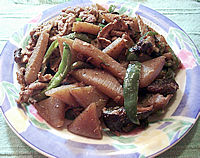
Pork and Konnyaku Miso Stir-fry

Makes 4 servings

Prep Time: About 1 hour

Ingredients:


  • 2 sheets of konnyaku, cut into triangles
  • 150 grams pork, cut into 4 cm strips
  • 1 tablespoon sesame oil
  • 1 small pack shiitake mushrooms, destemmed and cut into halves
  • 2 green peppers, cut into strips
  • 1/2 onion, thinly sliced
  • 2 cups cabbage, chopped
  • 3 tablespoons cooking sake, divided
  • 2 tablespoons soy sauce, divided
  • 2 teaspoons sugar
  • 1 teaspoons garlic, minced
  • 1 teaspoons ginger paste
  • 1 teaspoons togarashi
  • 1 tablespoon water
  • 30g miso paste 味噌
Preparation:
1.  Mix together 2 tablespoons sake, 1 tablespoon soy sauce, miso paste, sugar and water.  Add pork and konnyaku to the marinade.  Allow to marinate for about 20 minutes.
2.  In a frying pan, heat sesame oil over medium high.  Add onions to frying pan.  Saute until starting to become translucent.
3.  Add green peppers, cabbage and mushrooms to frying pan.  Saute for 3-4 minutes, or until green peppers being to soften.
4.  Add garlic, ginger, togarashi, remaining sake and soy sauce.  Saute for 1 minute or until fragrant.
5.  Add pork, konnyaku, and sauce.  Saute until pork has browned and sauce has begun to thicken.
6.  Serve with rice.
7.  Finished!


Monday, January 11, 2010

Soba そば


Soba, those thin buckwheat noodles often seen in Japanese restaurants, are one of the foods you're supposed to eat for the new year in Japan.  They're supposed to represent a long life and considering their health benefits, that might not be far off from the truth!  Soba is basically a fat free food that is also surprisingly high in protein considering it's a noodle.  Soba is also believed to help with high blood pressure due to the bioflavonoid present.

How to Prepare
You can find dried soba noodles at almost any supermarket.  Shiga has some particularly good dried soba made in Ibuki that can be found at most Heiwados.  Fresh soba noodles taste better and can usually be found in the fridge section of the market.  In the States, you should be able to find soba at any Asian market.

If you're feeling really adventurous, make your own soba noodles!  Mix equal parts wheat flour and buckwheat flour in a bowl.  Make a small indentation in your mixed flour and add a small amount of water.  Mix the water in with the flour.  Add enough water until you can make a fairly dry ball of dough.  When you pinch the dough together it should feel like you're pinched your earlobe.  If your dough is too wet or sticky, simple add some more buckwheat flour.

You should knead the dough for a long time.  20 minutes or longer.  You want the dough to fully form its gluten chains and to have no air pockets when you form it into a ball.  When you've think you've kneaded it for long enough, knead it for another 5 minutes to make sure.

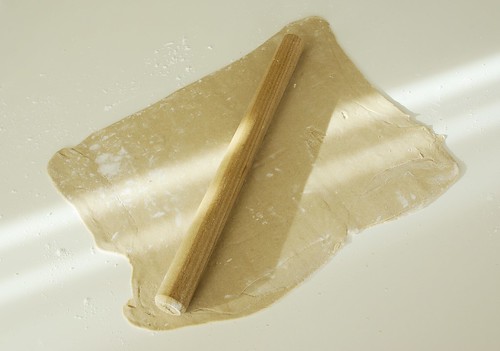
Lightly flour your counter with katakuri starch (片栗粉) or potato starch.  Flour your rolling pin with the starch as well and roll out your dough.  You want a large sheet like this:

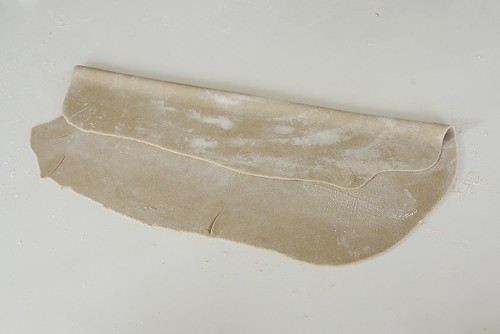
Next you will fold the dough into third with lots of starch to make sure it doesn't stick:


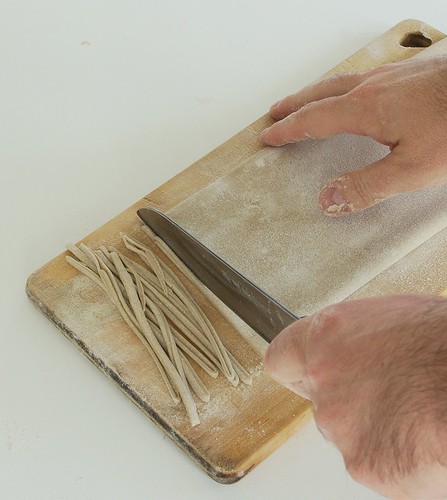
On a cutting board, cut the dough into thin strips to make the noodles.  Make sure your knife is sharp!

Finally you'll boil the noodles for about two minutes, then immediately wash them in cold water to stop them from cooking further.  Your noodles are done!

Easy Soba Recipe

Here's a non-traditional take on soba noodles, salad style!

Spicy Soba Noodles


Makes 4 servings

Prep Time: About 45 minutes

Ingredients:

  • 450 grams chicken breast, skin removed
  • 250 grams soba noodles
  • 1 tablespoon sesame oil
  • 3 tablespoons black vinegar 黒酢
  • 2 tablespoons soy sauce
  • 1 tablespoon chili oil
  • 2 garlic cloves, minced
  • 1/2 teaspoon sugar
  • 1 carrot, julienned
  • 6 small shiitake mushrooms, destemmed and thinly sliced
  • 1 red bell pepper, julienned 
  • 1 bunch mizuna 水菜, chopped (can substitute arugula)
  • 3 scallions, thinly sliced
  • 1 cup cooked edamame beans, pods removed

Preparation:
1.  Season chicken with salt and pepper.  Grill chicken until fully cooked (about 8 minutes each side).  Cut into thin strips and set aside.
2. While chicken is grilling, cook noodles according to package directions.  Drain noodles in a colander and rinse well under cold water to cool, then drain well. Toss noodles with sesame oil in a large bowl.
3.  Stir together vinegar, soy sauce, chili oil, garlic, sugar, and salt in another bowl until sugar is dissolved, then add to noodles and toss until coated.
4.  Add chicken, carrot, mushrooms, bell pepper, mizuna, scallions, and edamame to the bowl of noodles.  Toss together.
5.  Finished!


Saturday, December 12, 2009

Maitake 舞茸


You've probably noticed that the supermarkets have stepped it up in the mushroom department recently.  Fall means shrooms in Japan and the variety here is impressive.  This week we'll talk about maitake, which has weird, gross-sounding names in English like "Sheep's Head."  I don't know what kind of sheep the guy hangs out with that came up with that name but my sheep tend to be less mutated.  Like most mushrooms, maitake is a good source of selenium, B-vitamins and potassium.  It's also been shown in studies to help boost the immune system of cancer patients, so if you think you might have cancer stock up on maitake!

How to Prepare
Cut off the base of the mushroom where it still has some growing medium left on it (yuck).  After that, do whatever you feel like with it!  Chop, dice, shred, boil, steam, grill, the possibilities are endless.

Easy Maitake Recipe

One of my favorite recipe for autumn.  It's easy to modify with whatever you have on hand.

Mushroom Barley Soup


Serves 10 bajillion people (seriously, you'll get 8-10 servings easy from this)

Prep Time: About 1 hour

Ingredients:


  • 2 tablespoons olive oil
  • 1 large onion, thinly sliced
  • 2 ribs celery with leaves, diced
  • 1/4 cup parsley, finely chopped
  • 1 carrot, peeled and sliced
  • 3 cloves garlic, chopped
  • 1 small package maitake mushrooms, chopped
  • 1 small package enoki mushrooms, bottom 1/3 removed
  • 1 small package shiitake mushrooms, destemmed and sliced
  • 2 teaspoons fresh thyme, leaves removed from stems
  • 1 tablespoon flour
  • 8-10 cups water
  • 2 beef or vegetable bouillon cubes
  • 1 cup whole barley
Preparation:
1. Heat oil in a stockpot and sauté the onion, celery, 2 tablespoons of the parsley, carrot, garlic, thyme and fresh mushrooms until soft, about 5 minutes.
2. Lower the heat and add the flour, stirring every 30 seconds for about 5 minutes or until thick.
3. Add the water and bouillon cubes to the pot, constantly stirring, until vegetables are immersed.
4. Turn the heat to high, and add the barley. Stir well and add salt to taste.
5. Simmer, covered, for about an hour or until the barley is tender and the soup is thickened, stirring often.
6. Add additional chopped parsley, mix thoroughly, and adjust seasonings.
7. Finished!

You can add and subtract just about anything from this recipe.  I often like to skip the carrots and add zucchini when I can findthem on sale.